Highway User Tax Fund (HUTF)
HUTF funds come from gas taxes. This is the primary source of funding, making up 50% of the Road & Bridge budget. This tax base has not increased since 1993.
Gunnison County is exploring a countywide small sales tax increase to create a dedicated, reliable funding source for roads and bridges. By law, county governments cannot use property taxes to fund road and bridge maintenance, leaving Gunnison County largely dependent on limited and outdated revenue sources.
The proposed sales tax would be dedicated solely to roadway maintenance and surface transportation improvements. This funding would allow the County to properly maintain existing roads, improve safety and driving comfort, address long-deferred maintenance, develop needed infrastructure, and responsibly plan for future roadways.
A dedicated funding source would also provide greater flexibility within the Road & Bridge budget, strengthening the County’s ability to compete for large state and federal grants—helping leverage local dollars into major infrastructure investments that benefit the entire community.
Gunnison County is home to a diverse network of roads and bridges that allow the public to access the vast opportunities the County provides. This road network includes about 418 miles of pavement, gravel, and dirt County roads and hundreds of miles of other public roads. Currently, only 30 percent of the County roads are paved; the remaining 70 percent of roads in the network are gravel or dirt. Gunnison County Road and Bridge is responsible for snowplowing approximately 215 miles of road within the County, along with maintenance of roads within the County jurisdiction, and improvements to existing roads and new surface transportation infrastructure. Throughout the transportation network, the County is also responsible for 48 bridges and major culverts along County owned roads. The primary source of funding for Road and Bridge has been the Highway User Tax Fund (HUTF), a source of money accumulated by gas taxes; this tax base has not increased since 1993.
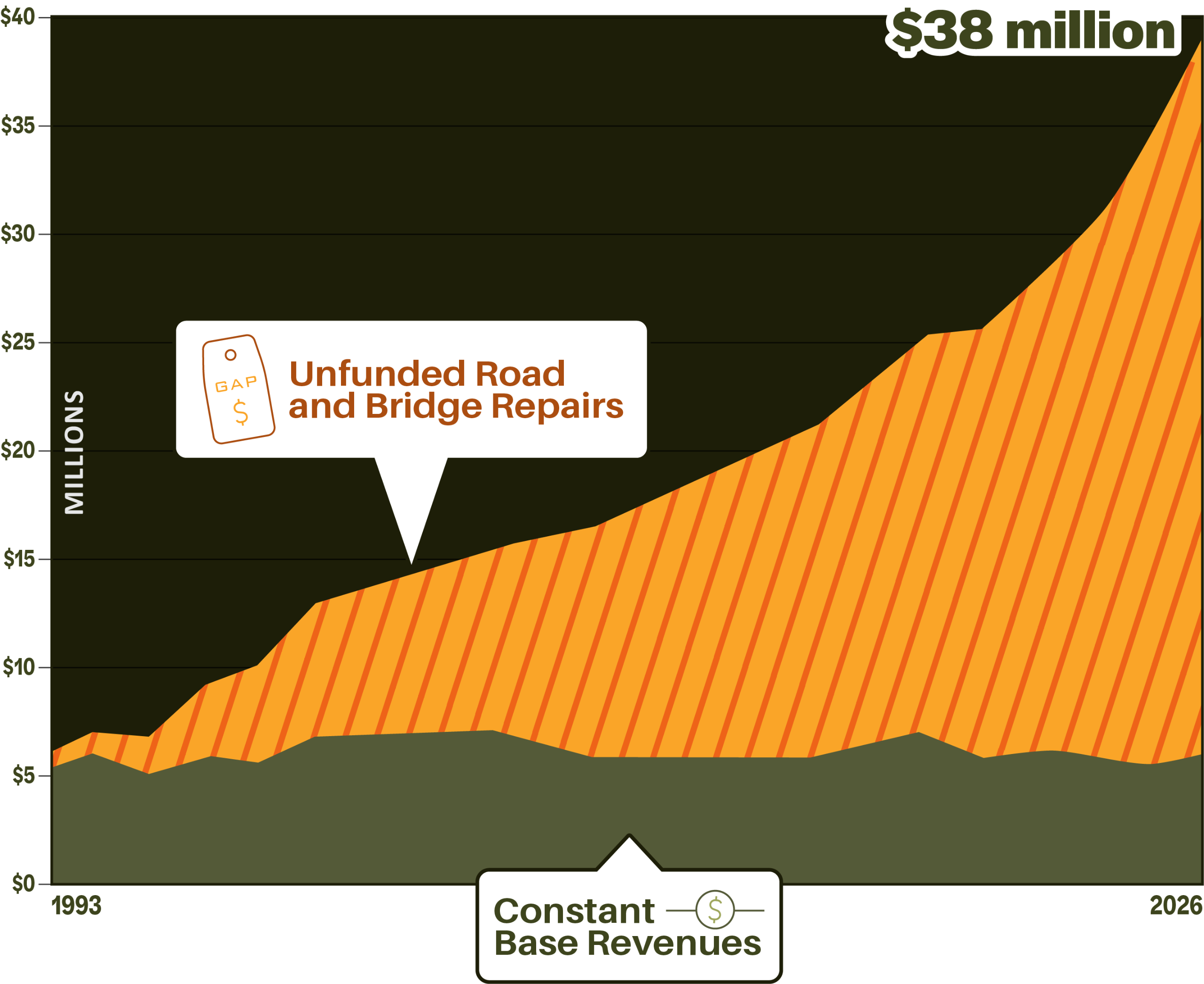
Since the late 1990’s, Gunnison County Road and Bridge department has had a constrained budget, while costs of materials and labor have continued to increase. Safety regulations and requirements for surface transportation are also ever changing, resulting in additional expenses meeting both state and federal requirements. With funding sources remaining stagnant, the department has had to adjust the maintenance of the roads from the “best” treatment, to the one that can be afforded on the constrained budget. The current state of Gunnison County roads reflects the hard choices that the department has had to make over the last 25+ years, where ride comfort and improvements have taken a backseat to simply keeping the roads open and maintaining safety. These hard choices have resulted in over 38 million dollars (and growing) in deferred maintenance to the County road network, which does not account for year-over-year inflation.
The image below displays a gap chart, which demonstrates how HUTF funds have not kept pace with inflation or modern transportation demands. Construction, materials, and labor costs have increased significantly, particularly since the pandemic. The County's effective purchasing power for road maintenance has declined by nearly 25 percent since COVID.
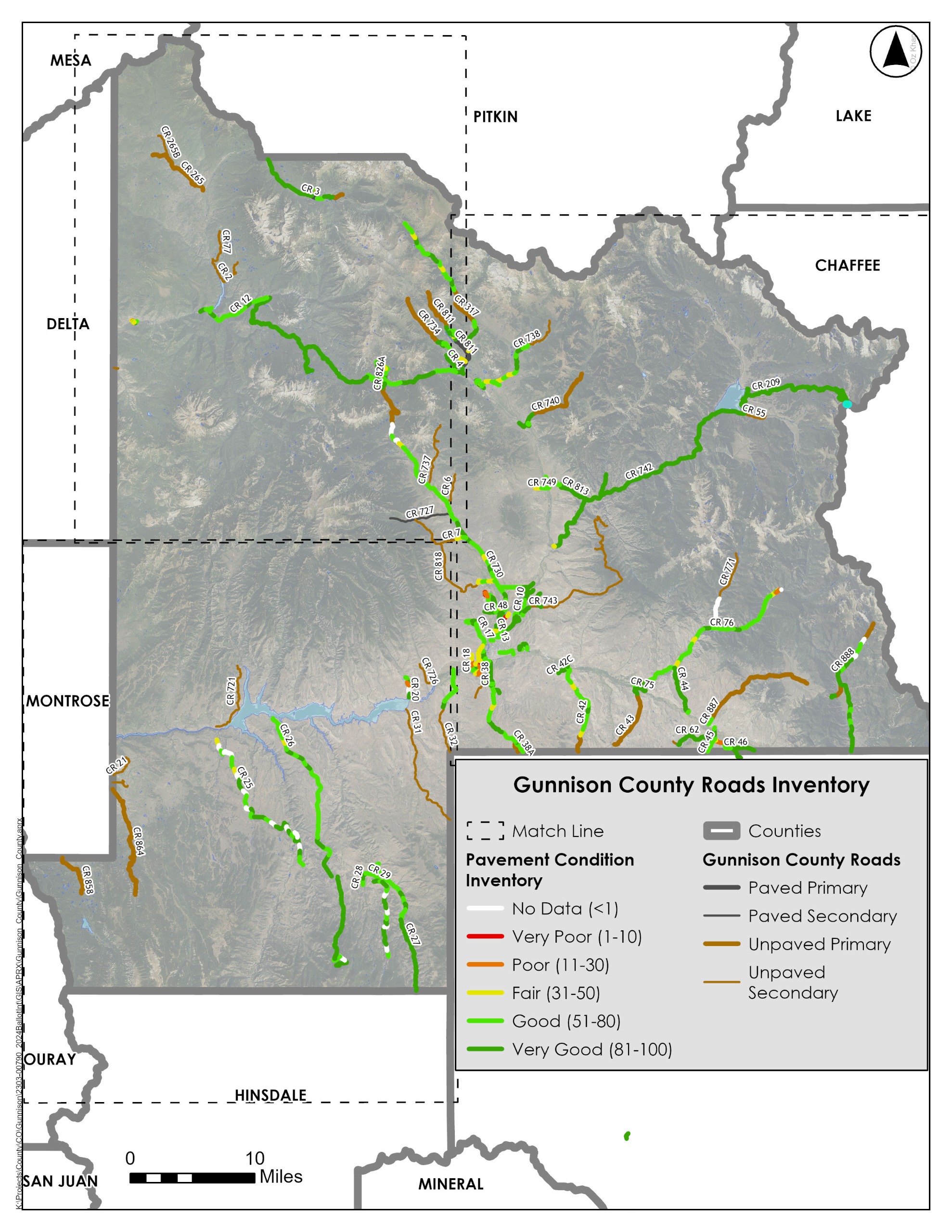
In 2025, Gunnison County completed a thorough pavement conditions assessment of paved and gravel roads within the jurisdiction to gain an understanding of existing conditions and future surface transportation needs. The study incorporated an independent, unbiased, AI-driven assessment of all County roads, which evaluated the condition of the roads and bridges. Through this assessment, it was determined that only 36 percent of the 418 miles of County maintained roads were rated in good condition, while 64 percent of roads are in fair or poor condition. The assessment also found that 5 of the 48 bridges were rated in poor condition and 21 bridges were rated in fair condition.
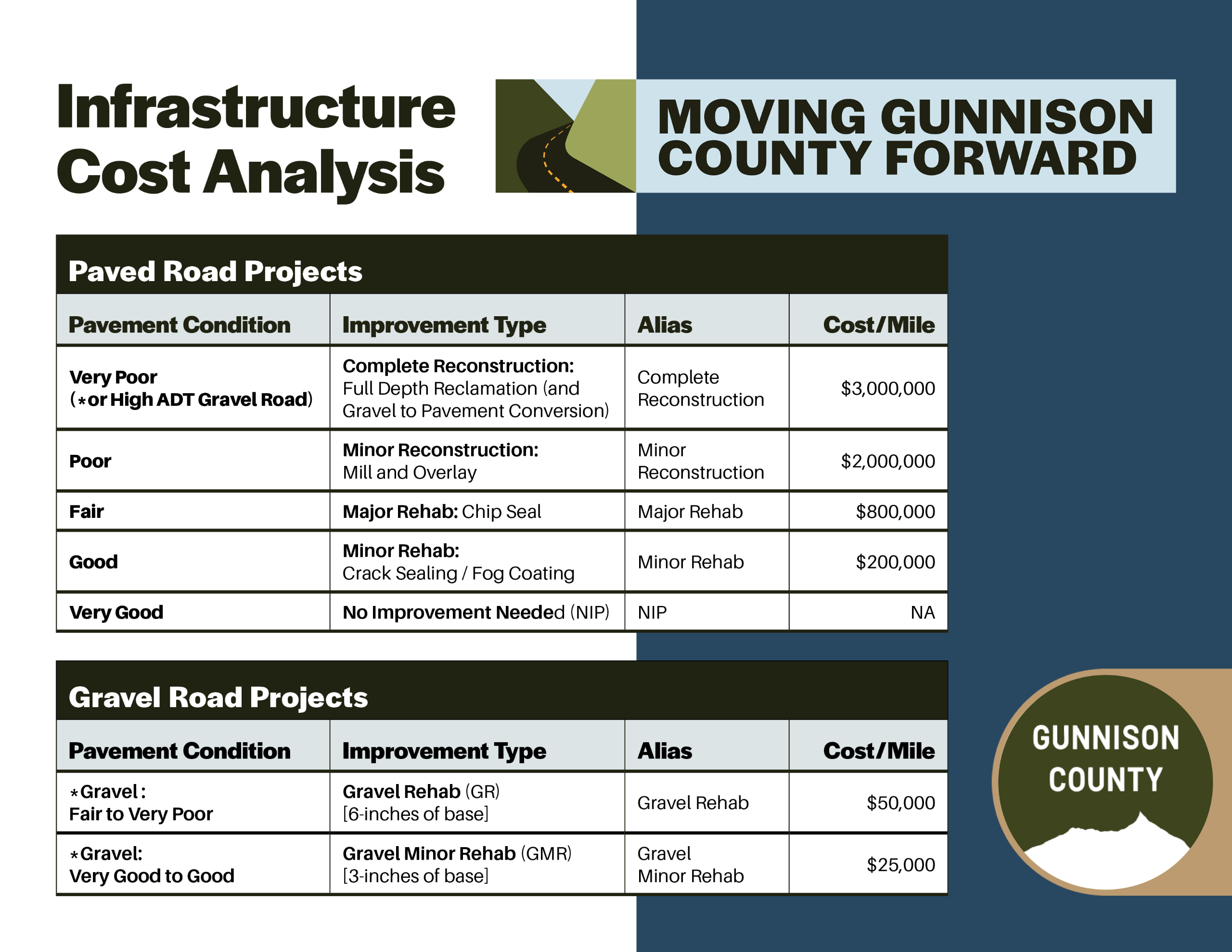
The existing conditions assessment identified improvements needed throughout the Gunnison County transportation system, which includes over 300 different projects. After identifying areas of needed improvement throughout the County, the project team conducted an infrastructure cost analysis using construction and engineering costs for road maintenance and construction on Colorado’s Western Slope. The cost analysis estimated costs for each segment of roadway based on the length of road and the type of improvement needed; it was determined that the total cost to perform all improvements would be $38,139,992. These calculations were done in 2025, and they do not account for year over year inflation; costs of labor and materials continue to increase each year.
The County completed a pavement conditions assessment of paved and gravel roads. The study incorporated an independent, unbiased, AI-driven assessment of all County roads, which evaluated the condition of the roads and bridges. The map shows pavement condition ratings of each of the roads driven through the assessment.
Learn more about Gunnison County Roads & Bridges with this short video series. Click each topic below for the video.
SHALL GUNNISON COUNTY TAXES BE INCREASED BY $3,811,363 ANNUALLY (ESTIMATED FIRST FISCAL YEAR DOLLAR INCREASE STARTING IN 2027), AND BY ANY ADDITIONAL AMOUNT AS MAY BE RAISED EACH YEAR THEREAFTER, THROUGH AN ADDITIONAL 0.50% (50 CENTS ON 100 DOLLARS) COUNTYWIDE SALES TAX TO COMMENCE ON JANUARY 1, 2027, FOR THE PURPOSES OF:
SUCH SALES TAX TO BE IN ADDITION TO ALL OTHER TAXES LEVIED BY THE COUNTY, SHALL NOT BE ALLOCATED IN WHOLE OR IN PART TO MUNICIPALITIES, AND THE PROCEEDS OF SUCH SALES TAX AND INVESTMENT INCOME THEREON, REGARDLESS OF AMOUNT, TO BE COLLECTED AND SPENT BY THE COUNTY AS A VOTER APPROVED REVENUE CHANGE UNDER ARTICLE X, SECTION 20 OF THE COLORADO CONSTITUTION?
YES/FOR
NO/AGAINST
Gunnison County has used funds from the HUTF, Federal Payments in Lieu of Taxes, Severance Taxes on nonrenewable natural resources that are removed from the earth, Specific Ownership taxes on vehicle registrations, and the newer, state FASTER tax that increased registration taxes. While these other sources of funds have kept the department operational, they are not adequate to offset costs and are widely variable thus resulting in their inability to plan projects in the future.
Over the past 25 years, Gunnison County has only been able to deliver larger projects through federal or state grants; however, many grants require matching funds. For example, a major infrastructure project totaling $15 million would require $3 million in matching funds, and this is currently not feasible within the current budget.
HUTF funds come from gas taxes. This is the primary source of funding, making up 50% of the Road & Bridge budget. This tax base has not increased since 1993.
PILT funds are federal payments to local governments that help offset losses in property taxes due to nontaxable federal lands within their boundaries. Typically, PILT funds make up 25 percent of the Road & Bridge Budget, however this funding source is not always guaranteed.
Severance Tax is a tax on nonrenewable natural resources that are removed from the earth, and these funds typically account for 12.5 percent of the Road & Bridge Budget.
Specific Ownership & FASTER funds are fees and taxes on vehicle registration, and they are specifically designated by the State of Colorado for roadway safety, repair, and transit. These funds typically make up 12.5 percent of the Road & Bridge Budget.
During the first phase of public engagement, the public was informed and invited to participate through workshop events with the Board of County Commissioners, two open house events, the project website, voter survey, and community presentations. Throughout this process, Gunnison County heard from 690 community members, including 54 participants at the public open house events, 73 online responses through the project website, 30 people attending community presentations, and 533 responses through the voter survey. It is also estimated that 3,897 people were informed about the project through various marketing and communication methods. View the complete Public Engagement Summary report.
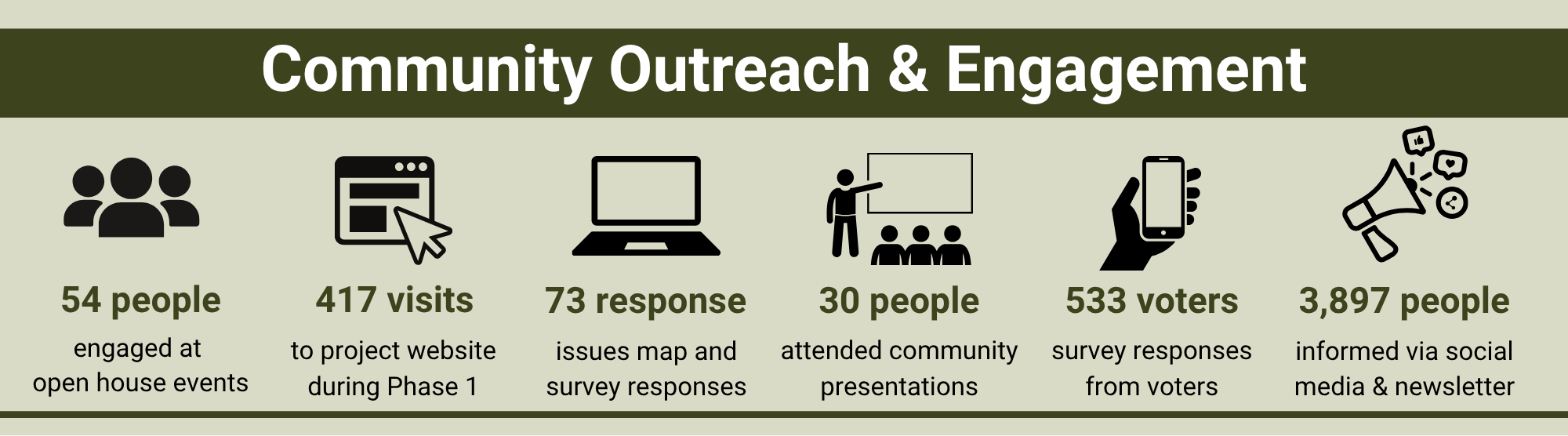
At the conclusion of the first round of public engagement, all public comments and survey responses were combined and tallied to create a clear understanding of community concerns and areas of need within the Gunnison County surface transportation system.
Areas of concern included water/sediment runoff, ditches not being deep enough or flooding, culverts plugged or damaged, and ditches that are not properly maintained.
General maintenance or road deterioration were most noted, followed by the need for cattleguard maintenance, pothole repair, washboarding, gravel replacement, gravel road repair, shoulder repair, along with a comment for road striping on Highway 135.
The most common safety concerns were related to the structure of the road including the slope, sharp curves, blind corners, and rockfall. Other concerns include spring flooding and freezing, speeding, illegal passing, EMS response time, ATV/OHV on the roads, and limited-no cell coverage.
Most comments were related to the concern with how the County is spending current funds, noting that they did not approve certain expenditures or that funds should be reprioritized towards road maintenance. Other comments expressed concern about a sales tax increase.
The comments ranged from the need for a safer bicycle experience, including the need for multi-use paths or separated bike lanes. Half of the comments were specific to Kebler Pass with some expressing the need to keep Kebler open year-round, while others enjoyed having the opportunity to cycle along the road without cars a few weeks each year. There was also a comment about realigning and paving Kebler Pass.
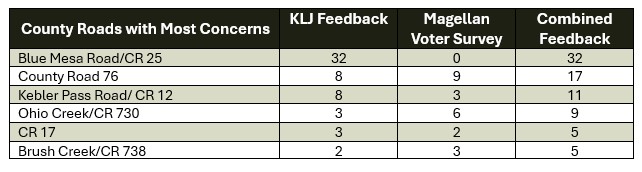
Using map pin locations from the project website, specific mentions of roads within public comments, comments from the voter survey, and feedback received during open house events, six roads rose to the top in relation to community concern. The roads with the most concern were ranked by the amount of public feedback received; Blue Mesa Rod/CR 25 received the most concerns, followed by County Road 76, Kebler Pass/CR 12, Ohio Creek/CR730, County Road 17, and Brush Creek/CR 738..